森田子龍

Exhibition

The Interplay of Copying and Creation: Masters of Modern Calligraphy

October 1–15, 2026

Nagai Art Gallery, Ginza, Tokyo

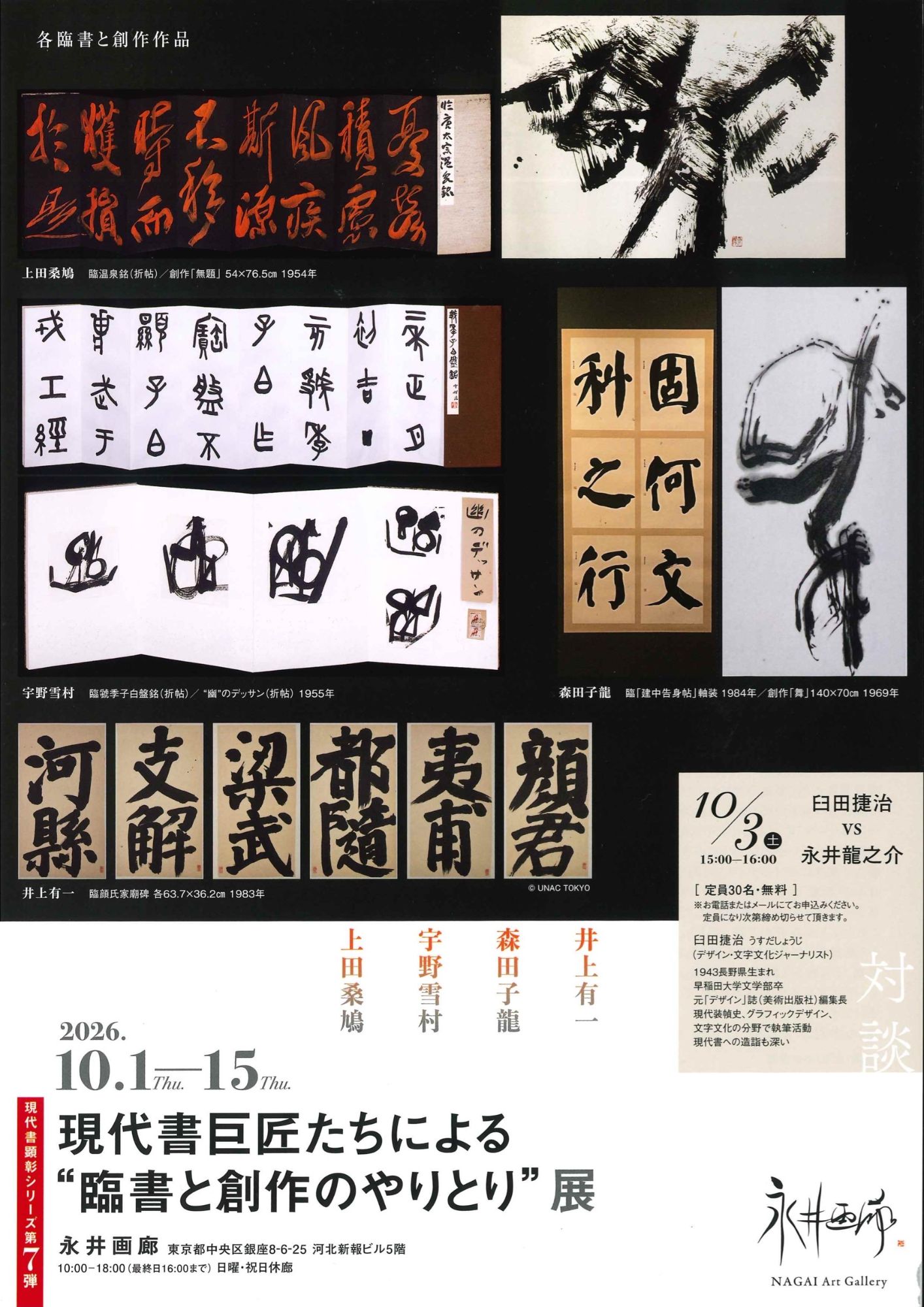
Ueda Sōkyū, Uno Sesson, Morita Shiryū, Inoue Yūichi

About the exhibition

Since 2023, Nagai Art Gallery has held a series of exhibitions asking what modern calligraphy means when seen from the vantage of world art. The series centers on calligraphers in the line of Hidai Tenrai, often called the father of modern calligraphy, among them Ueda Sōkyū, Uno Sesson, Morita Shiryū and Inoue Yūichi, and on the years when modern calligraphy and postwar art were sharpening each other.

This seventh exhibition in the series takes up rinsho, the copying of classical masterpieces. If a painter’s true ground is drawing, what is its counterpart for a calligrapher? Not an exact equivalent, but the answer that suggested itself was rinsho. The theme was proposed by Inada Sōsai, president of the Bokujinkai, who has often advised the series.

Copies after historic masterpieces are shown beside the original works that grew out of them, bringing each calligrapher’s essential art into view.

Artists and works

Ueda Sōkyū

1899–1968

Born in what is now Miki, Hyogo. He became a student of Hidai Tenrai in 1929, founded the Shodō Geijutsusha with Kaneko Ōtei and others in 1933, and founded the Keiseikai in 1940. His Ai (Love), shown at the 1951 Nitten, stirred debate, and he left the Nitten in 1955. A pioneer of avant-garde calligraphy, he taught Morita Shiryū and Inoue Yūichi, among others.

  • Copy of the Inscription on the Hot Spring, folding album
  • Untitled, 1954, 54 × 76.5 cm

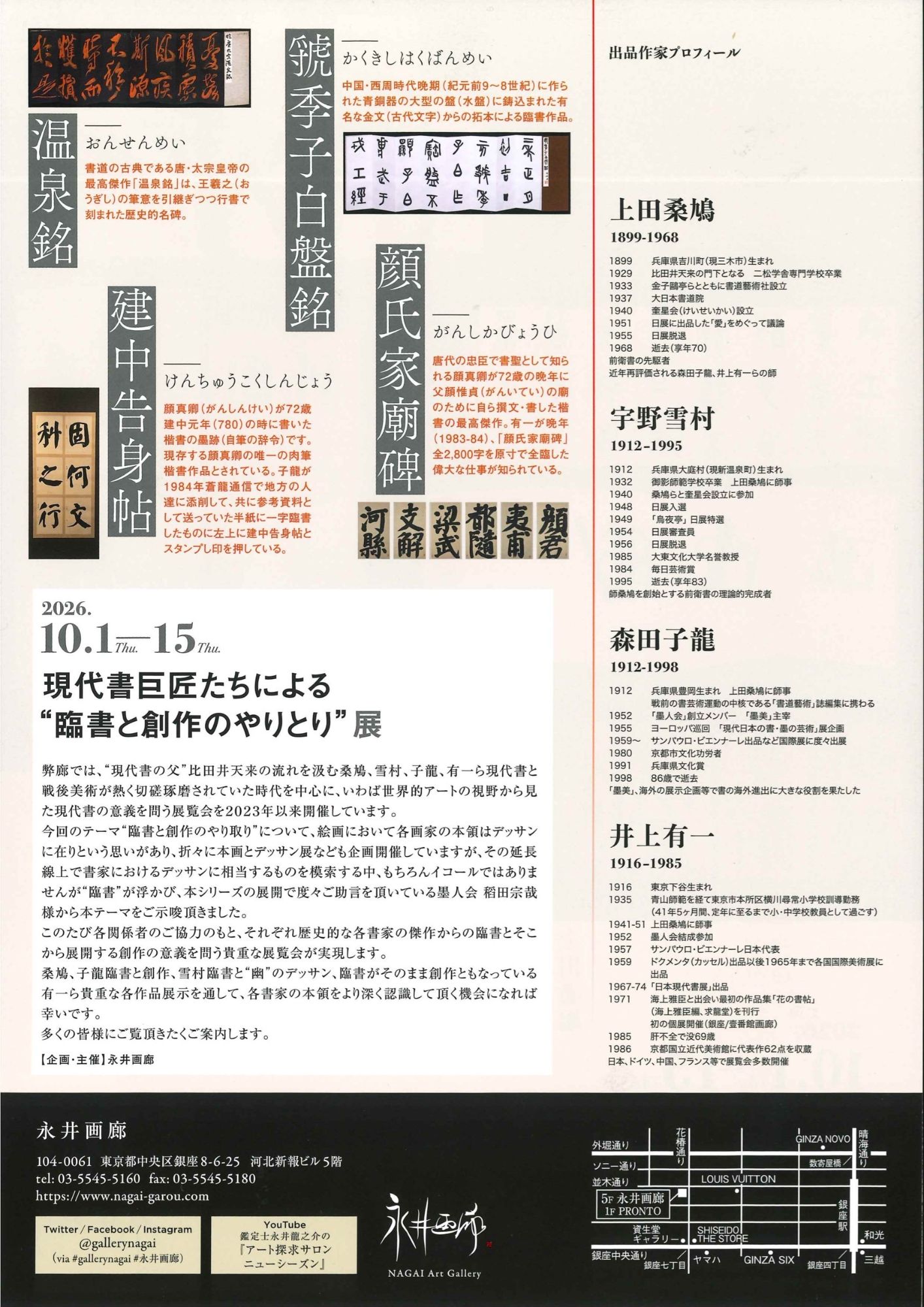
The Inscription on the Hot Spring 温泉銘, by the Tang emperor Taizong, is a classic of calligraphy: a historic stele carved in running script that carries on the spirit of Wang Xizhi’s brush.
Uno Sesson

1912–1995

Born in what is now Shin’onsen, Hyogo. He began studying with Ueda Sōkyū in 1932 and helped found the Keiseikai in 1940. He left the Nitten in 1956, became professor emeritus at Daito Bunka University, and received the Mainichi Art Award in 1984. He is regarded as the one who gave the avant-garde calligraphy begun by his teacher its theoretical completion.

  • Copy of the Inscription on the Guo Ji Zi Bai Basin, folding album
  • Drawings of the Character Yū “幽”のデッサン, 1955, folding album

The Inscription on the Guo Ji Zi Bai Basin 虢季子白盤銘 is a celebrated bronze inscription cast into a large basin of the late Western Zhou dynasty (9th–8th century BCE). Uno’s copy works from a rubbing of it.

Morita Shiryū

1912–1998

Born in Toyooka, Hyogo; studied with Ueda Sōkyū. In 1952 he formed the Bokujinkai and led the journal Bokubi. Through the journal and the exhibitions he organized abroad, he did much to carry sho beyond Japan.

  • Copy of the Kenchū Kokushin Jō, 1984, hanging scroll
  • Mai 舞, 1969, 140 × 70 cm

The Kenchū Kokushin Jō 建中告身帖 is a letter of appointment that the Tang calligrapher Yan Zhenqing wrote in regular script in his own hand in 780, at 72; it is said to be his only surviving original in that script. In 1984, when Morita corrected calligraphy sent to him from around Japan through Sōryū Tsūshin, he enclosed single-character copies of it on hanshi paper as models, each stamped “Kenchū Kokushin Jō” at upper left and sealed. The scroll mounts these sheets.

About Morita Shiryū

Inoue Yūichi

1916–1985

Born in Shitaya, Tokyo. From 1935 he taught in elementary and junior high schools for more than 41 years, until retirement. He studied with Ueda Sōkyū from 1941 to 1951 and joined in forming the Bokujinkai in 1952. He represented Japan at the 1957 São Paulo Biennial and showed at documenta in Kassel in 1959. In 1986, 62 of his major works entered the collection of the National Museum of Modern Art, Kyoto.

  • Copy of the Yan Family Temple Stele, 1983, each 63.7 × 36.2 cm

The Yan Family Temple Stele 顔氏家廟碑 was composed and written at 72 by Yan Zhenqing, revered as a loyal Tang statesman and a sage of calligraphy, for the family temple of his father, Yan Weizhen. It is counted the masterpiece of his regular script. Late in life, in 1983–84, Inoue copied all 2,800 characters at full size, work in which copying itself became creation.

Talk

Usuda Shōji and Nagai Ryūnosuke

Date
Saturday, October 3, 2026, 3–4 pm
Place
Nagai Art Gallery
Seats
30, free. Reservation required; booking closes when full.
Reservations
By phone or email to Nagai Art Gallery
Tel +81 3 5545 5160
info@nagai-garou.com

Usuda Shōji is a journalist of design and the culture of letters. Born in Nagano in 1943, he graduated from the School of Letters at Waseda University and is a former editor-in-chief of Design magazine (Bijutsu Shuppan-sha). He writes on the history of modern book design, graphic design and letterforms, and knows modern calligraphy well.

Nagai Ryūnosuke is an art appraiser.

Flyer

Front of the exhibition flyer: photographs of copies and original works by Ueda Sōkyū, Uno Sesson, Morita Shiryū and Inoue Yūichi, with the dates, the October 3 talk and the gallery’s address.
Front
Back of the exhibition flyer: Japanese text explaining the four classical models, the exhibition statement, the artists’ profiles, and the gallery’s contact details and map.
Back

The exhibition flyer from Nagai Art Gallery, in Japanese. Select an image to view it full size.

Venue

Nagai Art Gallery

永井画廊

Address
Kahoku Shimpo Building 5F (PRONTO café on the ground floor)
8-6-25 Ginza, Chuo-ku, Tokyo 104-0061
Hours
10 am – 6 pm, until 4 pm on the last day
Closed
Sundays and national holidays
Contact
Tel +81 3 5545 5160, fax +81 3 5545 5180
info@nagai-garou.com
Exhibition page, Nagai Art Gallery (in Japanese) Map (Google Maps)

Organized by Nagai Art Gallery.

Back to exhibitions